
News and Success Stories
Facilitating Digital Transformation in Developing Countries: A Holistic Approach in Shaping North Macedonia’s Digital Landscape
In the dynamic business landscape of North Macedonia, information and communication technology stands out as the single fastest-growing sector, reaching around 5% of the Macedonian GDP. Despite witnessing intensive growth, the absorption of digitalization by companies is still low. Even though about 90% of Macedonian companies have computer and Internet access, the percentage of companies with digital internal work processes is small. For example, only 14% of the companies received orders for products or services via computer networks or website, including services like online reservation and booking. The number of companies is even smaller (around 8%) of those tracking the orders or offering visitors customized online goods or services. One of the main challenges of Macedonian companies in the implementation of digitalization is the access of financial resources and technological expertise, necessary for the smooth implementation of this process, as well as the weak institutional infrastructure and lack of digital literacy.
 With a mission to cultivate an enabling environment, the Swiss Increasing Market Employability Program – IME, funded by the Swiss Agency for Development and Cooperation and implemented by the Palladium Group strategically focuses on cross-cutting digitalisation initiatives as a supporting development of two other high-growth sectors in the country – Sustainable Agribusiness and Sustainable Tourism. This article delves further into the development’s program multifaceted approach, harmonizing public and private sectors.
By working with private sector companies, business service organisations, and public sector representatives, the program takes a facilitative role in building capacities in the above illustrated market system. Thus, a credit line for digitization and digital transformation was championed by the Development Bank of North Macedonia, reflecting the Swiss experience, with an emphasis on participation of the private sector in shaping policies affecting them. In this way, access to finance and financial support was provided to facilitate the adoption of digital technologies. Through this credit line, the companies were provided loans from 5,000 euros to 100,000/300,000 euros depending on the type of investment. Consequently, during 2023, the banks granted digitization loans in the total amount of around 1.3 million euros with half of them intended for small companies.
As digital transformation accelerates, it is becoming crucial for businesses in non-ICT sectors like tourism and agribusiness to join the digital revolution or risk being left behind. Regular surveys and interviews with companies show they are interested in digital tools that will improve their performance. Such tools are systems for formalizing work with suppliers, process control software, business software, e-commerce, digital office and other productivity tools. Local agricultural companies are more interested in smart agriculture, such as using drones for spraying the crops, machines for harvesting finished products or other smart agriculture tools. Most of the companies are ready to invest in the initial stage of their digital process, and later, in introduction of advanced technology.
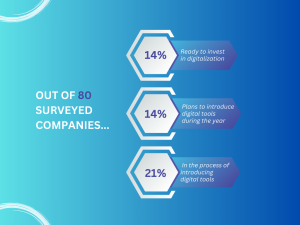
It is crucial to point out the broader push for digitalization across the tourism and agricultural-food sectors through the cooperation with the Fund for Innovations and Technological Development, a leading government institution supporting startups and innovative companies in the country. Placing a focus on the supporting functions like infrastructure, coordination, and access to market, the selected small and medium-sized enterprises (SMEs) under the public challenge ‘With Digital Transformation to Innovation’ are currently in the process of increasing innovation and digital transformation and overall productivity. At the same time, the capacities for additional digital innovation are also being strengthened, within the ecosystem necessary for further digital transformation.
In that sense, digital transformation specialists play a pivotal role by aligning technological solutions with business objectives and contributing to the competitiveness of organizations and firms. One such instance is the Center for Digital Transformation, designed to boost digital transformation of Macedonian economy and businesses, focusing on micro, small, and medium-sized enterprises (MSMEs). The Center actively supports the international certification of management consultants for digital transformation, provides expert analysis, develops strategies, supports implementation with vouchers, and establishes a repository of digitalization service providers.
 These endeavours represent a holistic approach to digital transformation, seamlessly integrating public and private sector efforts. They are all in alignment with the Smart Specialization Strategy of North Macedonia (2024-2027), as a document of high importance for the future growth of the Macedonian economy. The program’s role in digitalizing Macedonian business landscape is underscored by a commitment to strategic interventions and private sector engagement. Through alignment with the market system development approach, the program with its various partners assumes a significant role in paving the way for increased competitiveness, innovation and digital transformation, economic growth and sustainability.
Tanja Georgievska, Deputy Team Leader
Swiss Increasing Market Employability Program – IME
tanja.georgievska@thepalladiumgroup.com
Ema Jakimovska, Communications Manager
Swiss Increasing Market Employability Program – IME
ema.jakimovska@thepalladiumgroup.com


