
News and Success Stories
Innovation Driven by AI – Displacing Traditional Business Models
Over 300 participants were gathered to exchange knowledge, opinions, expertise and latest trends on AI during the 19th MASIT Annual Conference on Artificial Intelligence versus Workforce – through Adaptation to Innovation, in Skopje.
Is AI a threat, will AI replace humans, does the human remain always in the loop, would leaders hire someone without AI skills, is it the fittest who survives or is it the one who is most adaptable to change – were some of the questions posed during several vibrant and motivational panels at the conference. A practical share of expertise and knowledge, as well as a regional perspective and use of AI in agribusiness and tourism was the focus of the Panel “Innovation Driven by AI – Displacing Traditional Business Models”, moderated by Goran Damovski, Team Leader of the Swiss Increasing Market Employability Program.
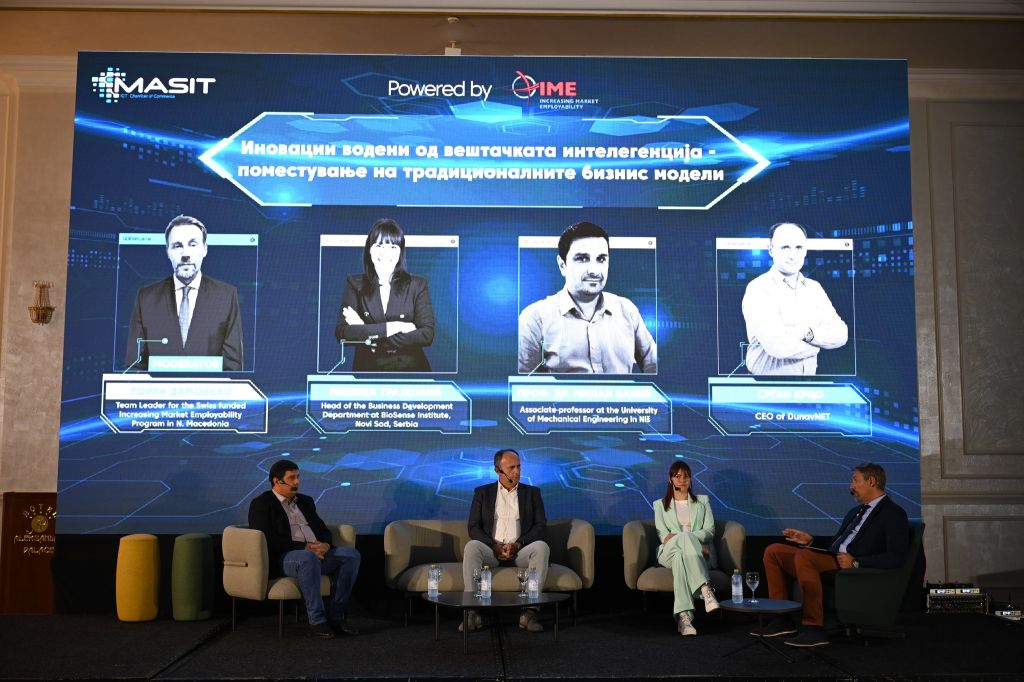
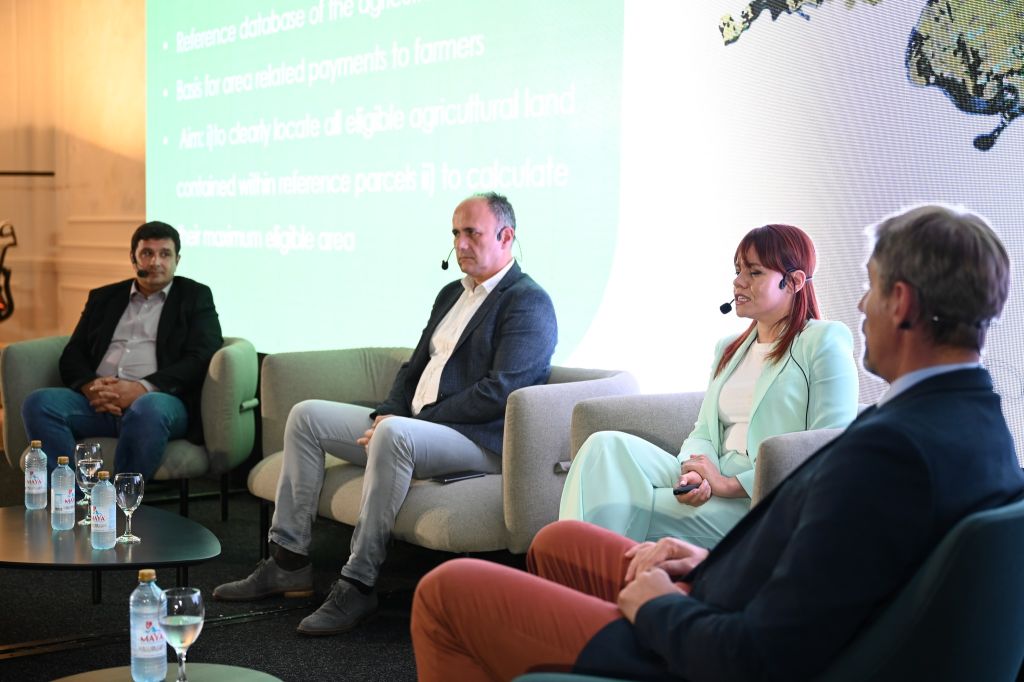
The leading Institute of research and development for information technologies of biosystems and a pioneer in digital transformation of agriculture, BioSense Serbia, represented by Milica Trajkovic, Head of Innovation and Business Development Department highlighted the implementation of the Land Parcel Identification System LPIS in Serbia.
“By collecting field data and using AI with 99% precision for the LPIS, Serbia has a reference database of its agriculture parcels. In this way, all eligible agricultural land contained within reference parcels can be located, and the maximum eligible area can be easily calculated.”
Trajkovic also introduced Treesury – a startup powered by BioSense Institute which connects hazelnut plantations with investors through regulated digital tokenized securities. This platform empowers farmers by simplifying funding, reducing production risks and enhancing operations with digital tools and regenerative agriculture practices, thus facilitating expedient production and securing market access.
“In this type of collective investment, anyone can be an investor, can sell the tokens or increase their share. This business model could truly change agriculture in Serbia. AI cannot replace humans; but it will surely increase the work in the digital realm. I think we will need more agronomists with knowledge for delivering online advice.”
Milan Banic, Associate Professor at the University of Mechanical Engineering in Nish, presented AgAR – an Agricultural Autonomous Robot. Equipped with software for remote control, predefined path movement, and autonomous navigation with obstacle avoidance sensors, AgAR is an ideal agricultural aid. “The AgAR robot based on AI is a project between an ICT company and a technical faculty. This is a great model showing how academia and industry can effectively cooperate. Now we are innovating with an addition, such as grape picking robotic arm. Nevertheless, we are still not there yet, I don’t believe AI will ever replace humans in this regard, as you know the “prokupac” variety is hard to pick even by humans themselves”.
Banic emphasized that AgAR aims to increase agricultural production and reduce operational costs, targeting medium and larger producers. However, he noted the challenge of convincing farmers to adopt new technologies. “Convincing farmers to use new technologies is hard! There lies the main challenge!”
When it comes to drones and workforce, the interesting thing is that you need three individuals to just execute the needed drone operations and for some operations like spraying larger plantations, drones’ capacity is rather limited. They have various possibilities, for example in multispectral scanning, although satellites offer wider views than drones, he further added.
Srdjan Krco, CEO at DunavNET, discussed the widespread use of AI in various industries. “75% of people are already using AI at work and 46% of them started using it less than six months ago.” His company works on IoT solutions in agriculture, tourism, and other sectors. One notable project is The Pearl Island in Doha, Qatar, where AI transformed the customer support center into a chatbot by integrating WhatsApp chats with their app, Microsoft Azure, and LLM, generating responses in English and Arabic.
Krco also highlighted their work on a generative AI-powered agronomy consultant, which is transforming agriculture in remote areas. This chatbot has a face and a voice, remembers previous communications, and helps build trust with farmers. “That is the hard thing with farmers – Building trust. And if you speak with someone with no face, and you must start from scratch, there is no relationship at all. With this solution we are also building that relationship.”
The session concluded with a discussion on the future of AI in tourism and agriculture. Krco mentioned the potential use of robotics in tourism, such as dual-arm robots in kitchens for cooking standardized dishes. He acknowledged the high cost of these solutions but pointed out the availability of open-source platforms for learning and implementing such technologies.
In summary, this year MASIT Annual Conference showcased the transformative potential of AI across various sectors, emphasizing the need for adaptation and innovation to harness its benefits while addressing workforce challenges.


